Democracy is a form of government in which the people have the authority to choose their governing legislators. The decisions on who is considered part of the people and how authority is shared among or delegated by the people have changed over time and at different speeds in different countries, but they have included more and more of the inhabitants of all countries. Cornerstones include freedom of assembly and speech, inclusiveness and equality, membership, consent, voting, right to life and minority rights.
The notion of democracy has evolved over time considerably,and, generally, the two current types of democracy are direct and representative. In a direct democracy, the people directly deliberate and decide on legislation. In a representative democracy, the people elect representatives to deliberate and decide on legislation, such as in parliamentary or presidential democracy.Liquid democracy combines elements of these two basic types.
Prevalent day-to-day decision making of democracies is the majority rule,though other decision making approaches like supermajority and consensus have been equally integral to democracies. They serve the crucial purpose of inclusiveness and broader legitimacy on sensitive issues, counterbalancing majoritarianism, and therefore mostly take precedence on a constitutional level.
TYPES OF GOVERNMENTAL DEMOCRACIES
Representative democracy involves the election of government officials by the people being represented. If the head of state is also democratically elected then it is called a democratic republic.The most common mechanisms involve election of the candidate with a majority or a plurality of the votes. Most western countries have representative systems.
Representatives may be elected or become diplomatic representatives by a particular district (or constituency), or represent the entire electorate through proportional systems, with some using a combination of the two. Some representative democracies also incorporate elements of direct democracy, such as referendums. A characteristic of representative democracy is that while the representatives are elected by the people to act in the people’s interest, they retain the freedom to exercise their own judgement as how best to do so. Such reasons have driven criticism upon representative democracy, pointing out the contradictions of representation mechanisms with democracy.
Parliamentary
Parliamentary democracy is a representative democracy where government is appointed by, or can be dismissed by, representatives as opposed to a “presidential rule” wherein the president is both head of state and the head of government and is elected by the voters. Under a parliamentary democracy, government is exercised by delegation to an executive ministry and subject to ongoing review, checks and balances by the legislative parliament elected by the people.
Parliamentary systems have the right to dismiss a Prime Minister at any point in time that they feel he or she is not doing their job to the expectations of the legislature. This is done through a Vote of No Confidence where the legislature decides whether or not to remove the Prime Minister from office by a majority support for his or her dismissal. In some countries, the Prime Minister can also call an election whenever he or she so chooses, and typically the Prime Minister will hold an election when he or she knows that they are in good favour with the public as to get re-elected. In other parliamentary democracies, extra elections are virtually never held, a minority government being preferred until the next ordinary elections. An important feature of the parliamentary democracy is the concept of the “loyal opposition“. The essence of the concept is that the second largest political party (or coalition) opposes the governing party (or coalition), while still remaining loyal to the state and its democratic principles.
Presidential
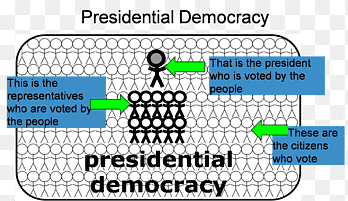
Presidential Democracy is a system where the public elects the president through free and fair elections. The president serves as both the head of state and head of government controlling most of the executive powers. The president serves for a specific term and cannot exceed that amount of time. Elections typically have a fixed date and aren’t easily changed. The president has direct control over the cabinet, specifically appointing the cabinet members.
The president cannot be easily removed from office by the legislature, but he or she cannot remove members of the legislative branch any more easily. This provides some measure of separation of powers. In consequence, however, the president and the legislature may end up in the control of separate parties, allowing one to block the other and thereby interfere with the orderly operation of the state. This may be the reason why presidential democracy is not very common outside the Americas, Africa, and Central and Southeast Asia.
 Knowledge